
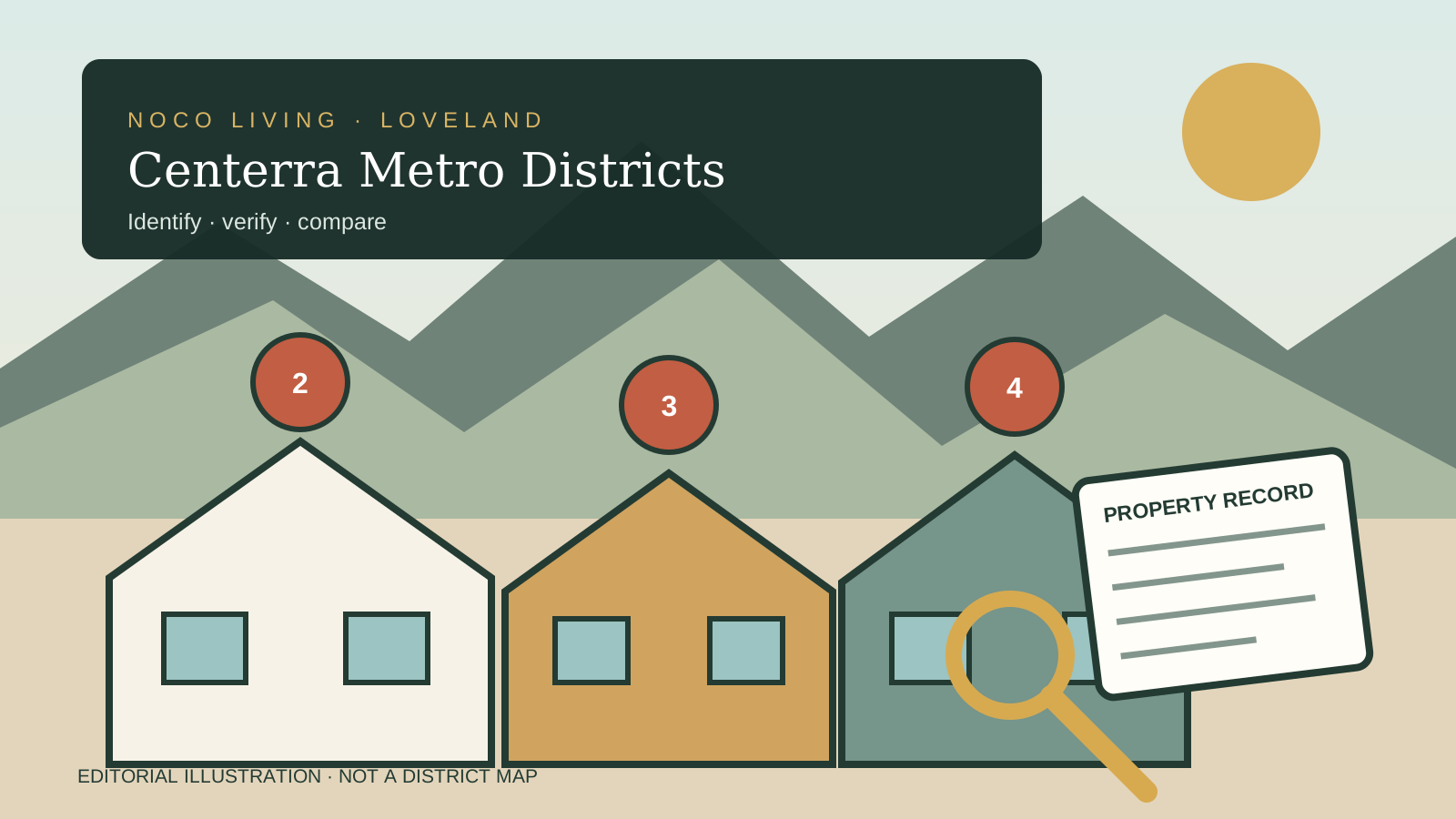
A Centerra home search can involve more than comparing floor plans, lot locations and HOA amenities. Properties in and around Centerra may sit in different metropolitan districts and tax areas, and the correct answer depends on the individual parcel—not the neighborhood name used in a listing.
This Centerra, Loveland metro district guide explains where to find official records and how to organize the questions. It uses sources reviewed on November 18, 2026 and provides general education, not legal, tax or financial advice.
What is a metro district in Loveland?
The City of Loveland's Metropolitan Districts page describes a metro district as a quasi-governmental special district with taxing authority. Districts can help finance public infrastructure and services that may include streets, sidewalks, water and sewer lines, parks, trails, green space and other improvements.
Each district operates under a service plan approved by the City. The service plan establishes the framework for the district, but it is not the same thing as today's property-tax bill, current budget or outstanding debt. Buyers need both the governing documents and current parcel records.
Loveland has required a disclosure document in title paperwork for property sales within a metro district since 2018, according to the City. That disclosure is important, but it should confirm—not replace—research performed before the deadline for reviewing title documents.
Centerra is not one single district or one tax rate
The City's Centerra service-plan index links records for Centerra Metropolitan District Nos. 1 through 5, including service plans, amendments and district filings. The official Centerra district transparency page also publishes maps, annual reports, budgets, audits or audit exemptions, board information and transparency notices for District Nos. 1-5.
That does not mean every home marketed as “Centerra” receives the same district line items. Nearby or overlapping districts can have different roles, boundaries and levies. The Lakes at Centerra districts, Kinston districts and other taxing authorities may appear in the broader area, depending on the parcel.
Avoid using a neighbor's bill, a builder estimate or a listing's shorthand as proof. Start with the exact street address and legal parcel.
Step 1: Identify the parcel and tax area
Use the Larimer County Assessor property search or its Public Data Portal to match the address to the correct parcel. County data includes the tax-area code and parcel-level fields for local-government, school and total mill levies.
Then review the most recent property-tax statement. Look for each taxing authority listed, not just a single “metro district” total. Save a copy of the statement used in your analysis and note its tax year, because assessed value, statewide rules and individual levies can change.
If the home is new construction and the current bill reflects vacant land, a partial improvement or an incomplete assessment, do not project future taxes by simply repeating that amount. Ask the assessor, title company, lender and appropriate tax professional how the completed property should be evaluated.
Step 2: Read the district's current financial records
Once the district is identified, move from the parcel record to the district documents. The Centerra Financial Documents page organizes budgets, budget amendments, audited financial statements and audit exemptions by district.
For the correct district, review:
- The current adopted budget and any amendments - The latest audit or approved audit exemption - The transparency notice and annual report - Outstanding bond or other debt disclosures - The current certified mill levy - Planned capital work, operations and maintenance responsibilities - Board meeting notices and recent minutes when a material change is under discussion
A service-plan levy cap is not necessarily the levy charged on the latest tax bill. Similarly, the existence of authorized debt does not tell you how much debt has actually been issued or remains outstanding. Use current records and ask for clarification when documents do not line up.
Step 3: Separate taxes, district fees and HOA dues
Metro district property taxes normally appear on the county tax statement. HOA dues and assessments come from a private association and are governed by separate documents. A property may have both, and each can fund different items.
Build a one-page cost sheet that lists:
1. The latest total property-tax amount and tax year 2. Each metro or special-district line item 3. Regular HOA dues and what they currently include 4. Any transfer, administrative or recurring district fees disclosed 5. Pending or recently approved special assessments 6. Utilities, insurance and other address-specific ownership costs
This prevents a common comparison mistake: treating a lower HOA payment as proof that the total ownership cost is lower.
Step 4: Review the title and purchase documents
Ask the title company for the recorded metro district disclosure, district-related covenants and exceptions that affect the property. Read the seller's disclosures, HOA resale package, current budget and meeting information within the contract deadlines.
Questions worth resolving in writing include:
- Which district or districts contain this parcel? - Which district levies appear on the latest tax statement? - Are the current taxes based on a completed home? - What district debt is outstanding, and when does it mature? - Are any fees collected outside the property-tax bill? - Which improvements are maintained by the City, district or HOA?
For a broader explanation of parcel-level tax comparisons, see the NoCo Living Larimer vs. Weld County property-tax guide. You can also use the Loveland community guide to compare Centerra with other Loveland locations based on your own priorities.
Centerra metro district FAQ
Does every Centerra home have the same metro district tax?
No. District boundaries and tax areas are parcel-specific. Verify the address through Larimer County records and the latest tax statement.
Is a metro district the same as an HOA?
No. A metro district is a governmental entity; an HOA is a private association. A home can be subject to both, with separate taxes, dues, rules and responsibilities.
Can the current tax bill change?
Yes. Assessed value, assessment rules and mill levies can change, and a new home's early tax bill may not reflect a completed improvement. Use the latest official records and obtain professional guidance for projections.
Comparing Centerra homes or reviewing a district disclosure? Contact Brandon Kite for help organizing parcel-specific questions and the records to request before your contractual deadlines.