
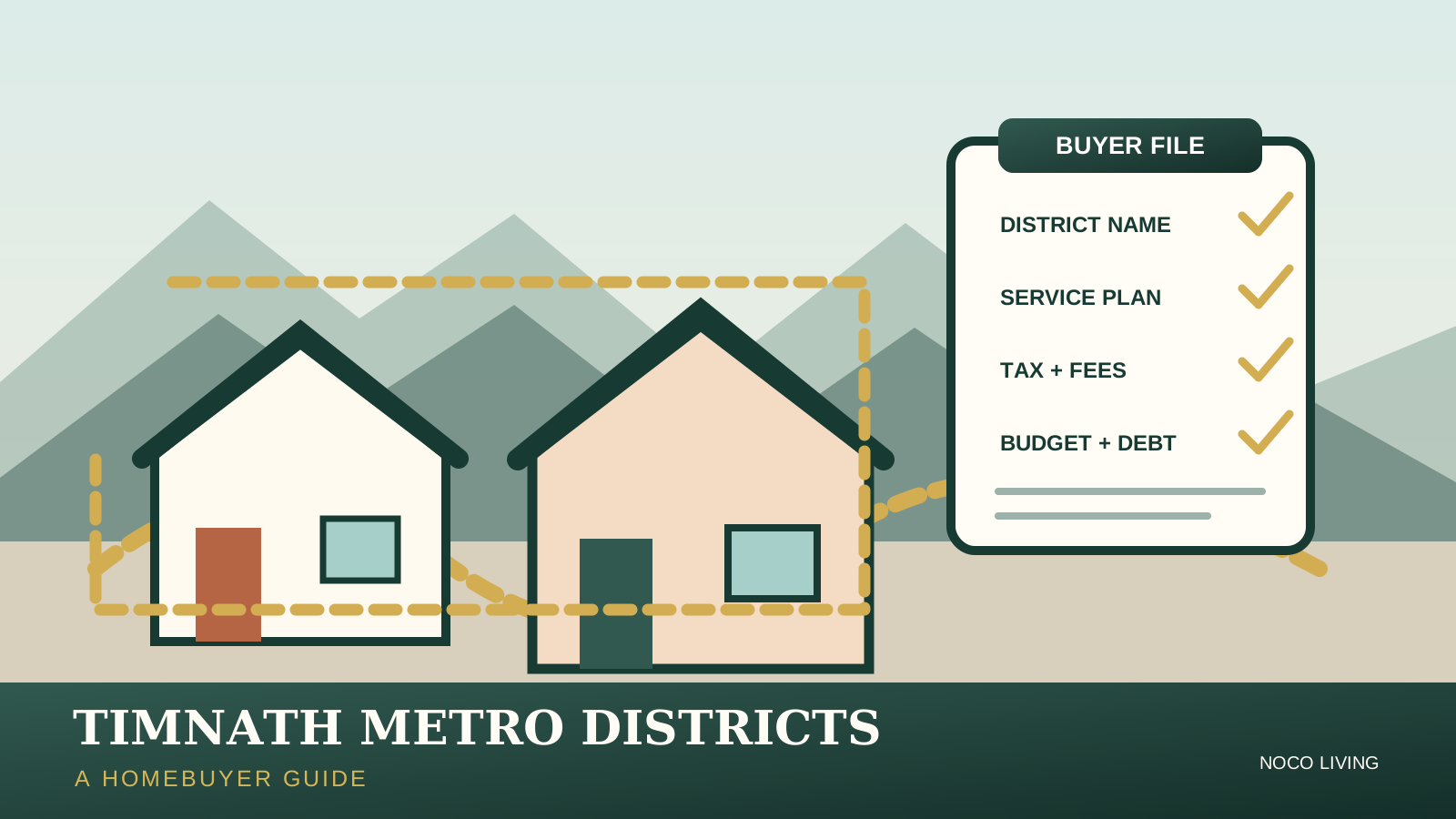
A Timnath home’s list price and HOA dues do not show its complete ownership cost. If the property sits inside a metropolitan district, the district may levy property taxes and charge separate fees to finance or maintain neighborhood infrastructure and amenities.
This Timnath metro districts guide explains how to identify the exact district serving a property, which documents to review and how to compare two homes without relying on a neighborhood-wide assumption. It is general educational information, not legal, tax or financial advice.
What is a metro district in Timnath?
The Town of Timnath metro districts page describes a metropolitan district as a special district and local-government unit authorized under Colorado law. Metro districts can finance public improvements needed for development and provide ongoing operations and maintenance for certain improvements.
The district is independent from the Town. Timnath Town Council reviews and approves service plans for districts within Town boundaries, but an elected district board governs the district. Current Town contacts include districts associated with Timnath Lakes, Timnath Ranch, Trailside, Wildwing, South Timnath, Southwest Timnath and Serratoga Falls.
A development name is only a starting clue. Some communities have several numbered districts with different roles, boundaries or financial obligations. Confirm the legal district name for the parcel rather than assuming every home with the same neighborhood branding has identical costs.
For a broader look at housing and location choices, start with the Timnath community guide.
Metro district versus HOA: review both
A metro district and a homeowners association are different entities. A district is a local government that may levy property taxes, impose authorized fees, issue debt and provide public improvements or services. An HOA is generally a private association funded through dues and governed by its declaration, bylaws and rules.
A home can be subject to one, both or neither. Do not treat a metro-district tax as if it were included in HOA dues, and do not assume paying district taxes eliminates an HOA assessment.
Ask for separate documents and separate cost figures. The title commitment, seller disclosures, tax records, HOA resale package and district materials should help identify what applies to the property.
How to identify the exact Timnath district
Start with the parcel number and the most recent property-tax statement. The Larimer County property and tax search links to the parcel record, tax calculation and payment history. Review the taxing-authority list and match the address and parcel number carefully.
Next, check the Town’s metro-district page for current district websites and management contacts. Request written confirmation if the district name, numbered entity or boundary is unclear.
The Colorado Department of Local Affairs Local Government Information System provides contact information plus budget and election filings submitted by local governments. Colorado’s special-district map can be a useful research aid, but DOLA warns that mapped boundaries are not guaranteed to be authoritative. Use it to generate questions—not as the final proof that a parcel is inside or outside a district.
Five documents worth reviewing
1. Service plan
Timnath calls the service plan the governing document for a metro district. It can describe permitted services, debt limits, mill-levy limits and other operating boundaries. Read the approved plan and any amendments that apply to the exact district.
2. Current and prior property-tax statements
The tax statement shows what was actually levied on that parcel for a particular year. Compare the district line item, total mill levy and total tax with the home’s assessed value. Tax rules, values and mill levies can change, so a prior bill is evidence—not a guaranteed future payment.
For help understanding the calculation, see the Larimer vs. Weld County property-tax guide.
3. Annual budget and current fee schedule
The annual budget shows expected revenue and spending. The fee schedule can reveal operations-and-maintenance charges that do not appear as HOA dues. Ask whether fees are billed monthly, quarterly or annually and whether any approved change is pending.
For example, Timnath’s Resolution No. 68, Series 2025 consented to a $125-per-residence monthly operations-and-maintenance fee for South Timnath Metropolitan District Nos. 1 and 2 effective January 1, 2026. That figure applies to those named districts; it is not a Timnath-wide fee.
4. Audit or financial statements
Review the latest available audit, or the applicable exemption filing, along with current financial statements. Look for outstanding debt, pledged revenue, reserves, major contracts and relationships among multiple districts in the same development.
5. Bond and disclosure documents
Bond documents can explain principal, interest, maturity, redemption terms and revenue pledged for repayment. The purchase contract or recorded records may also include a district disclosure. Ask qualified legal or financial professionals to explain anything you do not understand.
Compare homes using total ownership cost
When comparing two Timnath properties, use the same categories for each one: purchase price, estimated principal and interest, property taxes, metro-district fees, HOA dues, insurance, utilities and expected maintenance.
Then separate recurring charges from one-time costs. Confirm whether advertised amenities are owned or operated by the district, HOA, Town or another entity; whether access requires an additional fee; and whether planned facilities are complete, funded or still proposed.
If you are buying new construction, ask the builder for the district disclosure and current estimates, but verify them against public records. The Timnath utilities setup guide can help with the separate question of address-specific service providers.
Timnath metro district FAQ
Do all Timnath homes have a metro district?
No. District participation is parcel-specific. Verify the property record, title documents and district boundary information for the exact address.
Are metro district taxes included in the mortgage payment?
A lender may collect property taxes through escrow, but the loan estimate and closing documents control. Separate district fees or HOA dues may be billed outside escrow.
Can district costs change after closing?
Yes. Assessed values, mill levies, budgets and authorized fees can change. Review current records, approved limits and pending actions rather than relying only on a listing estimate.
Is the Town responsible for district debt?
The district is a separate entity. Review its service plan, financial statements and bond documents for property-specific due diligence.
Comparing Timnath homes or trying to organize district, HOA and utility questions before an offer? Ask Brandon about the property for real-estate guidance, then confirm legal, tax and financial details with the district, title company, lender and appropriate professionals.